There's a specific, minor kind of dread that comes with a small red light. Not the smoke detector's 3 a.m. chirp for a battery it doesn't need yet — the other one. The light on the air purifier, the water filter pitcher, the coffee maker. The one that means: pay again, or the thing you already paid for quietly stops doing what you bought it to do.
Most people don't clock this the first time. They clock it the second or third time, somewhere around month eight or nine, when they realize the $30 filter they just ordered is the same $30 filter they ordered in March, and the one before that, and that this is apparently just what owning the machine means now, indefinitely, for as long as it stays plugged in.
The Business Model Hiding Inside Your Appliances
The razor-and-blades model is old news in theory — sell the handle cheap, make the real money on blades nobody budgets for. Printers do it with ink. Coffee makers do it with pods. What's changed is how completely that logic has spread into categories that don't announce it up front, and air purifiers are close to the purest version of the trick, because the "consumable" isn't a minor accessory bolted onto the real product. It basically is the product. A purifier is, mechanically, a fan and a housing built around a filter — and the filter is the one part engineered to wear out.
That's not a conspiracy. Particulate filters genuinely do clog and lose efficiency as they trap dust, pollen, and pet dander, so replacement is a real function, not an invented one. But real doesn't mean disclosed. The number on the price tag at checkout has almost nothing to do with what the machine costs over the years you'll actually own it, and manufacturers have limited incentive to put that second number anywhere near the first.
What "Forever" Actually Costs
Run the math and the gap gets uncomfortable fast. A single HEPA filter typically runs $25 to $100, and most manufacturers call for a swap every six to twelve months — sooner if the unit runs around the clock, or there's wildfire smoke, pet dander, or a dusty apartment to contend with. Add it up across popular models and the pattern holds regardless of brand: somewhere between $35 and $100 a year in filters alone, on top of whatever the unit drew from the wall. Stretch that across the three to five years a purifier is designed to last, and the ongoing cost routinely catches up to, then passes, the price of the machine itself — on more than one popular model, independent cost breakdowns put the purchase price at under half the real lifetime total.
None of that shows up on the shelf sticker. It shows up in a browser tab eight months later, searching a filter model number at 11 p.m.
An Air Purifier Built Around a Different Bet
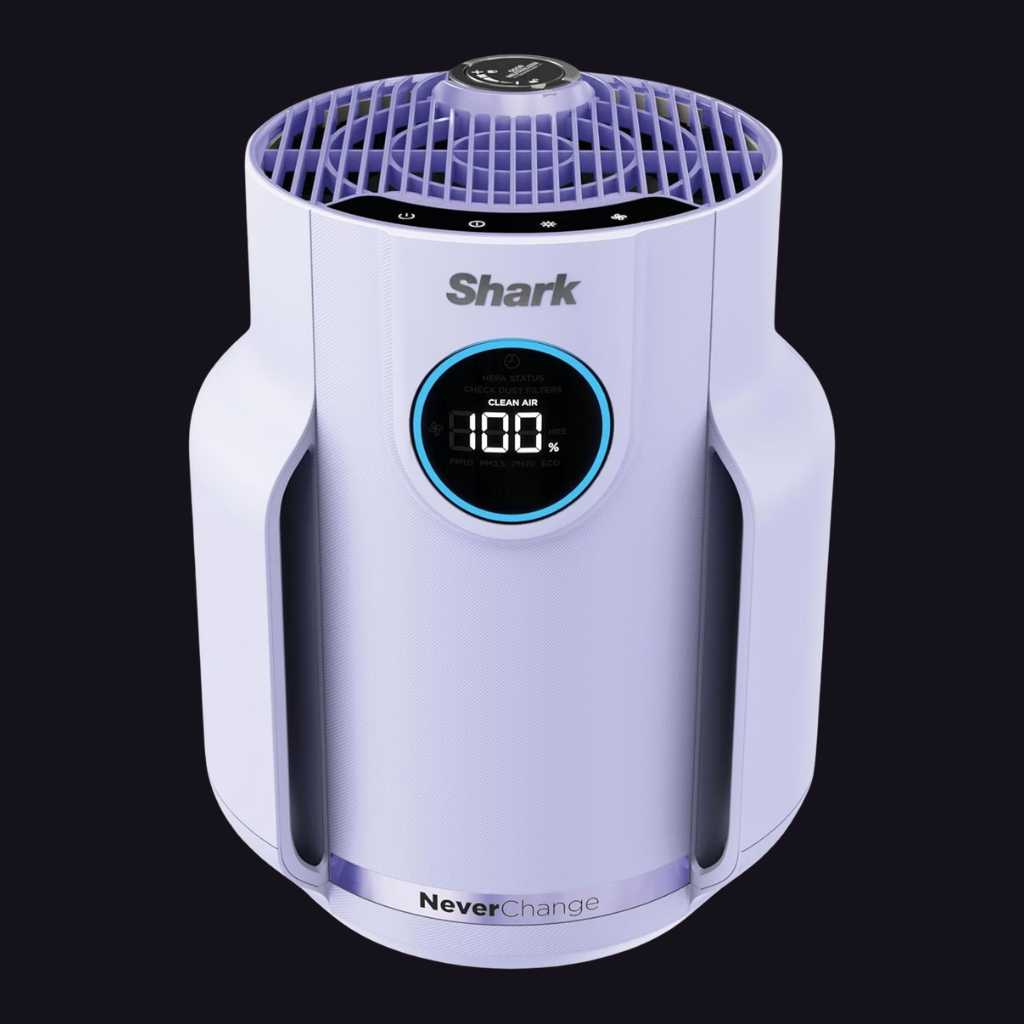
Shark's NeverChange Compact Pro is built around refusing that math specifically. The core claim: a HEPA filter engineered to run for up to five years without replacement, covering rooms up to 250 square feet and cycling the air in about an hour.
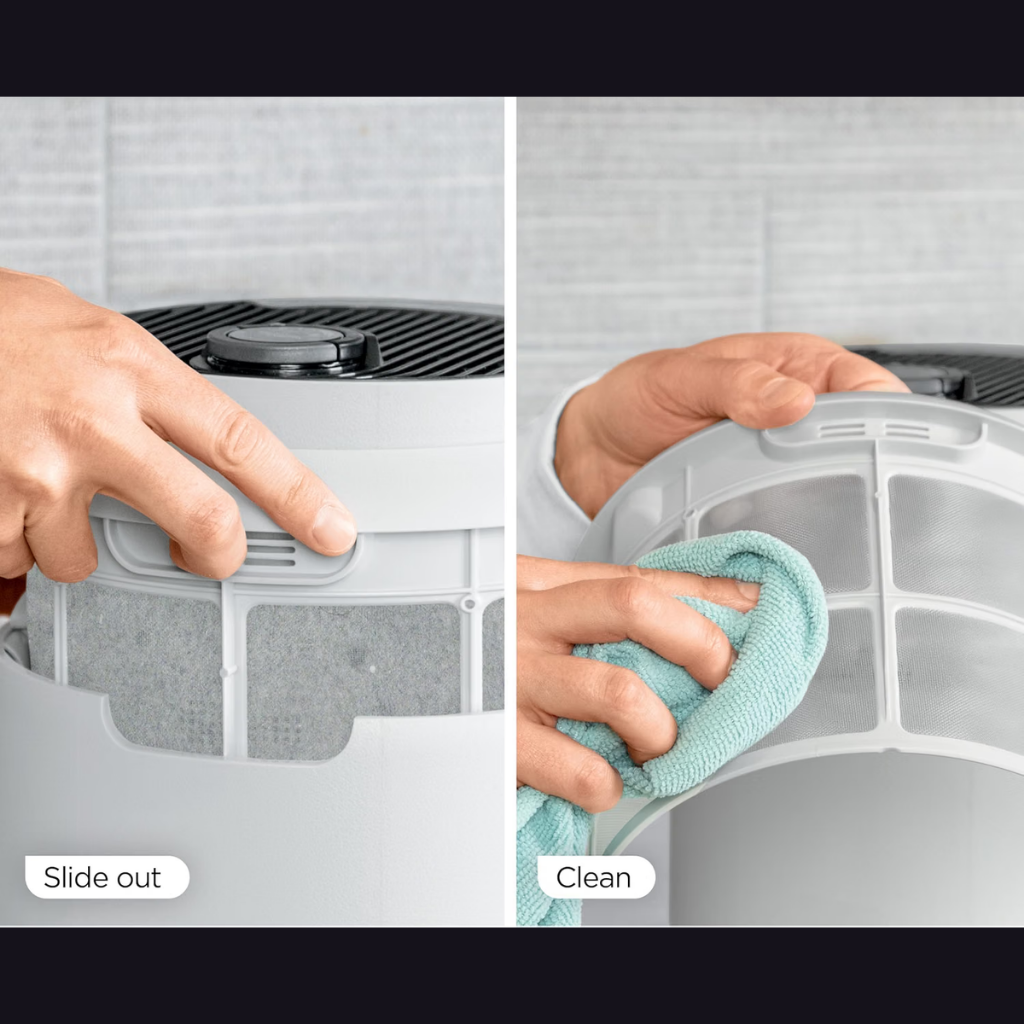
The mechanism is less mysterious than "never" makes it sound, and worth understanding rather than taking on faith. A washable Debris Defense pre-filter — the kind you vacuum, wipe, or rinse under a tap — catches the coarse stuff first: hair, larger dust, pet fur. That's the same job a cheap furnace filter does, and it's the reason the expensive layer underneath doesn't clog nearly as fast. The actual HEPA media sits behind that shield, rated to hold its particle-capture performance (Shark cites 99.98%, tested to the IEST-RP-CC007.3 standard down to 0.1–0.2 microns) for five years of normal use instead of one. A CleanSense IQ display shows live air quality as a simple percentage, so there's no guessing whether it's working or squinting at a filter trying to decide if it looks dirty.
Five fan speeds give you room to match output to the room without babysitting it, and dimmable status lights mean the display doesn't glow like a nightlight if this ends up on a bedroom dresser — which matters more than it sounds like it should, given Shark is marketing it squarely at bedrooms and nurseries. It also skips ionization technology, the kind of feature some purifiers lean on that has drawn scrutiny over incidental ozone output. There's nothing here to weigh against that trade-off, because there isn't one to make.
Worth being precise about what's actually covered: the five-year claim applies to the HEPA filter, which is the expensive part on almost every competing purifier. The unit also ships with a separate Odor Neutralizer cartridge for scent control — a smaller, genuinely optional consumable, not covered by the NeverChange claim, since it does a different job entirely. Skip that feature and you never buy for it again. A company selling "never change your filter" that quietly needed you to keep buying something else wouldn't have actually solved the problem, and it's a fair thing to check before taking the pitch at face value.
See Availability on Amazon →What You're Actually Paying For, and What You're Not
Shark's own comparison, based on its market-share data against ten leading competitor units priced under $150, puts the five-year savings at up to $150 in avoided filter purchases. Treat that as the manufacturer's math, not an independently audited one — but it's directionally consistent with the third-party filter-cost figures above, and the underlying mechanism, a washable pre-filter paired with a genuinely long-rated HEPA element, is real engineering, not a marketing footnote.
| Feature / Cost Factor | Typical Compact Purifier | Shark NeverChange Compact Pro |
|---|---|---|
| Upfront Purchase Price | ~$100 – $150 | $179 (frequently on sale) |
| 5-Year Filter Replacements | 5–10 filters (~$125 – $500+) | $0 (5-year HEPA filter) |
| Ongoing Maintenance | A recurring purchase | A washable pre-filter, rinsed occasionally |
Be fair about the other side of that ledger, too. At 250 square feet of rated coverage, this is sized for a bedroom, nursery, or home office, not an open-plan living room, and it carries a higher upfront price than the cheapest bare-bones compact purifiers on the market — some of which move more air per dollar if raw purification speed for the room size is the only thing being optimized for. The trade being made here isn't "more power for less money." It's "solidly adequate power, indefinitely, without the recurring bill." Those are two different products solving two different problems, and it's worth being honest about which one you're actually shopping for before lining up price tags side by side.
The Quiet Rebellion Against Paying Twice
The interesting thing here was never really about air purifiers. It's a slower, less dramatic cousin of the subscription fatigue everyone already recognizes in streaming and software — the specific irritation of discovering that a thing you thought you'd finished paying for was actually just getting started with you.
A five-year filter doesn't end that pattern everywhere; the printer still wants ink, the coffee maker still wants pods. But it's a concrete data point in a larger shift: enough people have now done the filter-cost math out loud, in enough reviews and forum threads, that "we removed the recurring cost" has become a headline feature manufacturers advertise rather than fine print they'd rather you skip. That's a real change in what buyers are willing to tolerate, not just a product spec.
The best appliances, in the end, are the ones people stop thinking about entirely — not because they've gotten used to paying for them, but because there's nothing left to keep paying for. That's a strange thing to get excited about. It's also, increasingly, the whole pitch.
See Availability on Amazon →